

I am sure a lot of you have seen the Black History Month Exhibit up in the Media Center! I am sure you would be wondering how many more people out there who definitely deserve to be mentioned in Black History too! Here are some for you to see!
Frederick Douglass (1818 – 1895)
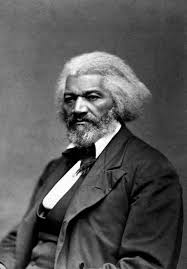 Frederick Douglass was actually born into slavery roughly around 1818 in Talbot County, Maryland. He soon became on of the most intellectual people of his time! He had advised to presidents, and lectured thousands on a lot of causes, such aswomen’s rights and Irish home rule.
Frederick also wrote several autobiographies describing his experiences in slavery such as the book, Narrative of the Life of Frederick Douglass, an American Slave. He died on February 20, 1895.
Jesse Owens (1913 – 1980) (athletics)
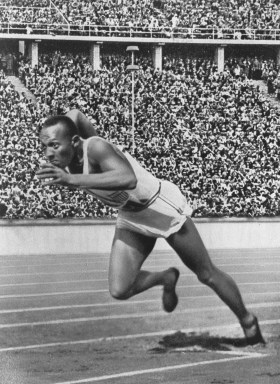
Jesse Owens was born on September 12, 1913. He was also known as “The Buckeye Bullet” and was an American track and field athlete. At the 1936 Olympic Games in Berlin, he won four gold medals and broke two world records.
Owens’ athletic career of track and field had begun in high school, when he won three track and field events at the 1933 National Interscholastic Championships. Two years later, when he was competing for Ohio State University, he equaled one world record and broke three others before even qualifying for the 1936 Olympics. He died on March 31, 1980.
Phillis Wheatley (1753 – 1784) (poet)
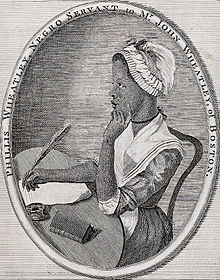 Phillis Wheatley was born in Senegal/Gambia around 1753. At the age of 8, she was kidnapped and brought to Boston, Massachusetts on a slave ship. Upon her arrival, John Wheatley bought her as a servant for his wife, Susanna.
Under the family’s direction, Phillis was taken under Susanna’s wing. It was hard to notice her intelligence, and as a result, Susanna taught Phillis to read. Therefore, at a time when African Americans were discouraged from learning how to read and write, Phillis’ life was an anomaly.
Poems on Various Subjects was a landmark achievement in U.S. history. Phillis became the first African American and first U.S. slave to publish a book of poems, as well as the third American woman to do so.
As a strong supporter of America’s fight for independence, Phillis wrote numerous poems in honor of George Washington. Phillis even sent one of her works, written in 1775, to the future president. As a result, she received an invitation to visit him at his headquarters in Cambridge, Massachusetts. She accepted the offer and soon visited Washington in March of 1776.
Phillis Wheatley did continue to write, but the growing tensions with the British and, ultimately, the Revolutionary War, weakened enthusiasm for her poems. While she tried contacting various publishers, she was unsuccessful in finding support for a second volume of poetry.
Phillis Wheatley died in her early 30s in Boston, Massachusetts, on December 5, 1784.
Sojourner Truth (1797 – 1883) (Abolitionist & Feminist)
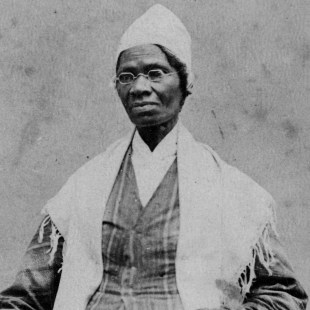 Sojourner Truth, who was born as Isabella Baumfree, in 1797, was an African-American abolitionist and women’s rights activist best-known for her speech on racial inequalities, “Ain’t I a Woman?”, delivered in 1851 at the Ohio Women’s Rights ConVention. Truth was born into slavery but escaped with her infant daughter to freedom in 1826.
She devoted her life to the abolitionist cause and helped to recruit black troops for the Union Army. Although Truth began as an abolitionist, the reform causes she sponsored were broad and varied,
Sojourner Truth (born Isabella Baumfree, c. 1797 to November 26, 1883) was an African-American abolitionist and women’s rights activist best-known for her speech on racial inequalities, “Ain’t I a Woman?”, delivered extemporaneously in 1851 at the Ohio Women’s Rights Convention. Truth was born into slavery but escaped with her infant daughter to freedom in 1826. She devoted her life to the abolitionist cause and helped to recruit black troops for the Union Army. Although Truth began her career as an abolitionist, the reform causes she sponsored were broad and varied, including prison reform, property rights and universal suffrage.
 Grover Middle School's Jagazine