

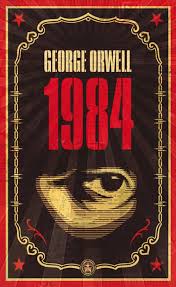
 Sometimes you read a book that is more than just merely a book. It is an idea that changes eons to come, wrapped in a layer of solitary confinement composed of hundreds of pages smooth to the touch, like the dawning of a new day, or a new society, or a new world. Sometimes, you read a book that is even more than an idea. The book is a last hope to a world overcome by narcissism, greed, and corruption. Books can leave the world a better or worse place than what it was found… it’s all up to the writer and their twisted or golden (depending on one’s moral compass) writings of what we once were, what we are now, and what we will become. The glorious champions of the waxing human race? Or the sludging, creaking rats of the last dawn? Or, you could read 1984, what many would consider to be the most influential book of all time. This book is a multi-purpose tool of enlightenment or destruction. Written in 1949, during the spread of Communism, Socialism, and general corruption, 1984 is a warning sign for generations to come. If we continue to tread down this path of socialism, liberalism, and dangerous technological advances, then Armageddon could be closer than any of us ever imagined. We could let the government control our thoughts, our beliefs, and our individuality, all of which we value as American citizens. At least, that’s what Orwell thought as he was passionately, furiously writing down this text on his deathbed. But Orwell’s thoughts have slowly submerged into our own, making him the spokesman of a century of fear, corruption, greed, and the downfall of the human race.
This book takes place during… 1984 (which is, interesting enough, the year that the movie came out) in a post-apocalyptic Oceania, which, geographically, consists of Great Britain, the Americas, the Oceania that we know today, and the Caribbean along with various Pacific islands. The other two global powers (the world is divided into three) are Eurasia (Portugal through Russia) and Eastasia (Mongolia, Tibet, Korea, China, Japan, etc). The protagonist, Winston Smith, is a bland, dilapidated 39-year old man with a retching cough and a varicose ulcer. He works for The Party, the ruling government of Oceania that teaches the principles of Ingsoc (English Socialism). Ingsoc runs by the following phrase: “War is peace, freedom is slavery, and ignorance is strength.” The leader of The Party is a figure named Big Brother. Citizens of Oceania must truly love Big Brother with all their hearts. They must swim in his river, they must sleep in his bed, they must walk where he walks. Big brother is love, Big Brother is everything, and Big Brother always watches you. Winston grapples with self-doubt and paranoia as he harbors inner resentment against the Party and its ideals. He meets a 24-year old woman named Julia, who alters his point of view, and introduces him to an uncensored reality, where thought is freedom, and freedom is the ability to say that 2 + 2 = 4, just because. That is a bare-bones synopsis of the text without any further detail (to prevent spoilers), but the text is much more than that. It’s a philosopher’s fantasy.
What makes the text appealing? Why do people turn back to this book and compare it to the escapades of today? Why have the book sales increased during the dawn of the Trump presidency? I could reveal these answers to you, and be an obnoxious little braggart. However, the answers become evident as the text is read. However, this text is not merely read. It is glanced over, then absorbed, then it resonates. You hear the grinding of the cogs turn, you see the mildew dissipate, you begin to think. You turn off the TV, you turn off the video games, you take out the earbuds, you throw down the computer, and you begin to contemplate. Just a morsel, just a droplet of muse. It’s refreshing. You will likely experience that sensation as or after you read, but the effect is still as everlasting. Many men (and women) have stated this: 1984 may not be the greatest book of all time, but it is certainly the most influential.” There is little to dispute there. Because of this book, we have been forever wary of our leaders and the policies they implement. We do not want Ingsoc, Neo-Bolshevism, Death-Think, or any leading political philosophy in this text’s society to take root in ours. When we, as American citizens, observe corruption in our governmental proceedings, where do we turn back to? This book… this book and what it taught us. This book is our societal warning sign. We turn to this book for guidance, and it lavishes us with truth and prose in return.
What makes the book so incredible, besides its societal insinuations? Is it the story (which is very interpretive), the characters, the setting? It’s a concoction made out of all three, with the underlying messages from before added to it. The characters are deep and multi-layered. Nothing’s set in stone, and characters can change significantly within the span of a paragraph. Everybody’s corrupt in one way or another. There are no good characters, and there are no bad characters. Everybody has deep flaws. There is no hero/heroine, and the protagonist does not triumph at the end of the text. Instead, he succumbs to greater forces. However, to me, that makes the text more appealing. A reader may crave a simplified ending. They may want a pretty little package of a text, with a neat little ribbon to tie it all up. The hero saves the day, gets the pretty girl, defeats corruption at the core, etcetera. That’s not the way society works, and I think that we are all aware of that. Some readers do not want questions. They do not want to contemplate. They want answers. They dread cliff hangers. But, some readers see the beauty. Where others see fault, they see the flower begin to bloom. This book certainly caters more to the latter…
The setting exudes a dark, foreboding presence. It oozes a state of disarray, an ever-so corrupt state of disarray where the citizens of Oceania do not acknowledge or realize said disarray. This war-torn, oppressive, totalitarian government meshes beautifully with the characters, characters who harbor feelings of resentment, characters who fantasize over capitalism. The contrast provides the plot, a plot that turns right back to the same ideals of Oceanic Socialism favored by the society at the beginning of the text. The setting is dark, grungy, biased, and thought-provoking, based off of the ideals of the proletariat masses, or the “proles” as the text likes to refer to them as. The Party favors this working class, so that they can establish their (morally wicked) ideals.
1984 is a shining example of a book that is not merely a book, or a collection of pages, or an assortment of letters. It is a prophetic message, a message for the future. It is an everlasting message of corruption… corruption that can be avoided if government does not become almighty today. The main character, Winston, represents the optimism of today, whilst The Party represents the pessimism of tomorrow. The book gives us lessons for today, while examining issues from the past (this text was written in 1949, post-World War II). Do we need this book, or does this book need us? Both apply. Let’s look to tomorrow with this book as a guide. We don’t want this society, and we don’t want these circumstances. As cliche as this sounds, we need to work together to make the world a better place. We need to move on from the past and make paths for tomorrow.
Final Verdict: 9.7/10
 Grover Middle School's Jagazine