

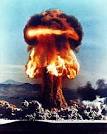
 To start with, let me explain what an explosion is. An explosion is the “rapid increase in volume and release of energy in an extreme manner”. There are three general different types of explosions:
Mechanical- A mechanical explosive is an explosion that depends on a physical reaction, like overloading a container with compressed air.Such a device has some application in mining, where the release of gas from chemical explosives may be undesirable, but otherwise is very little used.
Chemical- A chemical explosive is an explosion that comes from a chemical reaction. The chemical called Nitroglycerin can’t combust( warm up and explode) but it can expand rapidly which causes an explosion. Chemical explosives can be classified as low or high explosives. Low (or deflagrating) explosives are used mainly for pushing things in a particular direction. They are mixtures of substances that can combust(e.g., gunpowder) that when set off (by ignition) makes a chemical reaction and that makes rapid combustion. High explosives (e.g., TNT) are used mainly for shattering; they are unstable molecules that can experience combustion without any oxygen and the chemical reaction produces shock waves.
Nuclear- This is one of the most deadly explosion, and it can happen in one atom. This is when an atom splits apart or has an impact with another particle with a release of energy. The energy release is so massive, it is equivalent to approximately 75 million sticks of dynamite. Nuclear explosions can release high levels of radiation, energy that removes electrons from atoms and can damage DNA.While areas around a nuclear explosion are immediately exposed, radiation can also remain in the atmosphere for decades, traveling great distances before it settles to the ground-level air or Earth’s surface.
Citations
https://www.dosomething.org/facts/11-facts-about-nuclear-disasters
http://www.encyclopedia.com/science-and-technology/chemistry/organic-chemistry/explosive
 Grover Middle School's Jagazine